
What is a “Cool Climate” Wine, Really? (Let’s Review Data from the Russian River)
At a Glance: Russian River Valley Cool Climate
- Region: Russian River Valley AVA, Sebastopol, CA
- Ocean Distance: ~12 miles from the Pacific Ocean
- Growing Season Temp: 55°F–75°F avg.; diurnal swing up to 40°F
- Fog Pattern: Morning fog burns off by midday; cool breezes return by late afternoon
- Primary Soils: Sebastopol Sandy Loam (Wilson Grove Formation)
- Key Varietals: Pinot Noir, Chardonnay
- Estate Vineyards: Quail Hill (45 acres), Susanna’s (20 acres), Adam’s (7.1 acres)
- Winemaker: Pete Soergel
- Farming Since: 1980, 45+ years of continuous estate farming
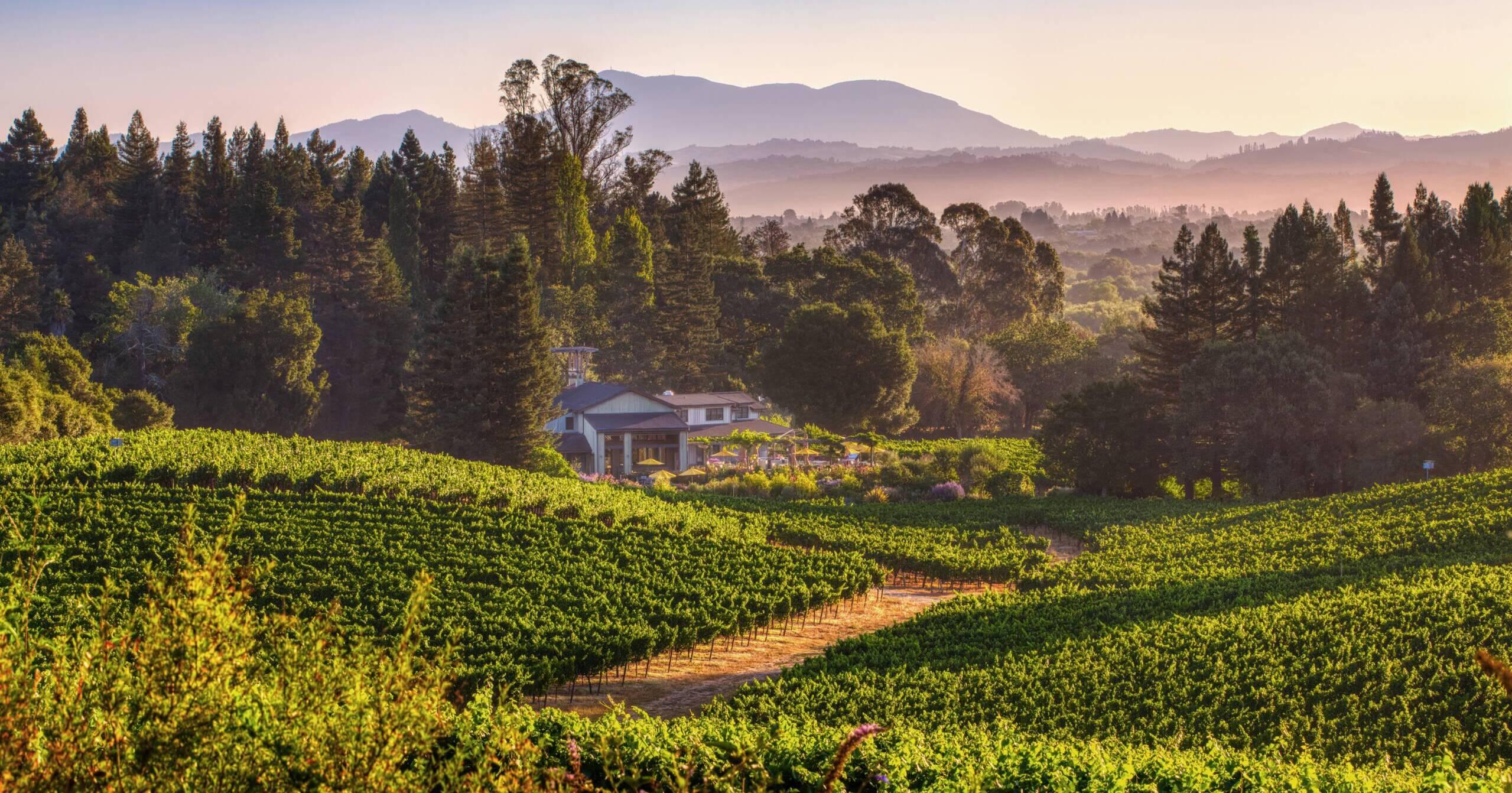
Just before dawn, Quail Hill Vineyard is cloaked in fog. The cool air settles in — sometimes 40 degrees less than the afternoon that preceded it. The vines stand still in the dark, patient and quiet, and there is something in that stillness that tells you everything about the wines they will eventually produce.
“Cool climate” is a phrase that gets used often in the world of wine. It describes regions where the average growing season temperature falls between 50°F and 68°F — cool enough to slow ripening, warm enough to ripen fully. The Russian River Valley in Sonoma County, California, is one of the world’s benchmark cool climate regions for Pinot Noir and Chardonnay, sitting just 12 miles from the Pacific Ocean. But the numbers alone don’t tell the story. What makes this place extraordinary is the daily rhythm of the land — the fog that comes and goes, the soil that struggles and gives, the winds that arrive with purpose. At Lynmar Estate, we have watched this rhythm for more than 45 years. What it has taught us lives in every bottle we make.
How Does Temperature Define a Cool Climate Wine Region?
In viticulture, temperature is the organizing principle behind everything. Viticulturists use a measure called Growing Degree Days (GDDs) — the cumulative warmth a vine experiences above 50°F from April through October — to understand how a region grows its grapes. Burgundy, France, the ancient home of Pinot Noir, averages approximately 1,800–2,000 GDDs per season. The Russian River Valley averages roughly 1,800–2,200. The parallel is not coincidental; it is the reason this valley has drawn such reverence from winemakers and wine lovers alike. (UC Davis Viticulture & Enology)
What this means in practice is something you can feel in the glass. Grapes ripening in a cool climate develop flavor over a longer period. Rather than racing toward sugar in summer heat, they take their time — building the layered aromatics that cannot be rushed. The red cherry, the forest floor, the wild strawberry, dried herbs, and faint whisper of cola that make Russian River Pinot Noir so distinctive: these come from patience. The slower the ripening, the deeper the flavor map.
At Quail Hill Vineyard, the growing season follows a rhythm that we have come to know the way you know a dear friend — by its patterns, its surprises, its reliable gifts. The mornings are cool and often misted over. The fog retreats as the day warms. By late afternoon, breezes return from the coast, and by evening, the temperature can fall by as much as 40 degrees from the day’s high. Lynn has always called it “Goldilocks weather.” Not too warm. Not too cold. Just precisely what Pinot Noir and Chardonnay need to become something worth opening slowly, worth savoring, worth keeping in your cellar for years to come.
What is the Petaluma Gap, and Why Does It Matter for Russian River Wine?
There is a break in the coastal mountains to the south of us — a natural corridor called the Petaluma Gap — through which the Pacific sends its winds each day with remarkable force and regularity. Recognized as its own American Viticultural Area in 2017, the Gap is not just a geographic footnote. It is a force that shapes this valley’s wines as surely as anything we do by hand.
Those winds arrive at Quail Hill in the morning hours, pressing back the fog that settled overnight, drying the vineyard canopy, cooling the fruit during the afternoon hours when heat accumulation would otherwise run unchecked. They reduce disease pressure from mold and mildew — a quiet but essential service to the health of the vine. And they ensure that even on warm days, the grapes themselves never lose the cool-temperature character that defines this place.
The result is something you can taste. Chardonnay here keeps its lemon curd brightness, its mineral tension, rather than tipping into the heavy, overripe tropical fruit of warmer regions. Pinot Noir develops its silk-like tannins and vibrant acidity — the hallmarks of the Russian River style. The Petaluma Gap is invisible. But you taste it in every glass.
How Does the Laguna de Santa Rosa Influence the Microclimate at Quail Hill?
Lynn always liked to say that Quail Hill is not just one thing — it is a conversation between forces. And one of the most important voices in that conversation is the one most visitors never see.
The Laguna de Santa Rosa runs along the eastern edge of our property — a 22-mile sanctuary of creeks, marshes, wetlands, and oak woodlands stretching from Cotati to Forestville. It is ancient and alive, and it shapes our microclimate in ways we are still discovering. When evening fog rolls in from the coast, the cool southwesterly winds interact with the moist air rising from the Laguna, creating a temperature buffer that moderates the night’s chill. In the mornings, westerly winds flow down toward the Laguna, carrying the fog back and opening the east-facing slopes to early sunshine — warming the vines at precisely the right moment, without overheating the fruit.
Later in the day, as the sun moves west, the east-facing slopes fall into longer shadows. The Laguna’s cooling breezes return. The acidity that the day’s warmth has been building is gently preserved.
Three forces — the Pacific, the Petaluma Gap, and the Laguna de Santa Rosa — converge here at Quail Hill in a way that is, as far as we know, genuinely singular. It is the reason the wines taste the way they do: precise and layered, with a sense of place that is unmistakable and impossible to replicate anywhere else.
What Role Does Soil Play in Cool Climate Wine Quality?
Lynn always said that great wine begins with great vineyards. And great vineyards begin with great soils.
Beneath Quail Hill lies Sebastopol Sandy Loam — part of the Wilson Grove geological formation, shaped by earthly forces over the course of 4 to 5 million years. These soils are naturally nutrient-poor and well-drained, with an average rooting depth of 36 to 40 inches. To the uninitiated, “nutrient-poor” might sound like a liability. Here, it is a gift. (USDA Web Soil Survey)
When vines must struggle — when the soil gives them enough to survive but not enough to become lazy — they focus their energy on the fruit. The clusters come in smaller. The berries are tighter. The flavors are more concentrated. Our vineyard manager has never hesitated to say that this soil is our most valuable asset. What we do to the vines matters enormously. What we do between them matters just as much.
Within those soils, there is also remarkable diversity. Topsoils and subsoils exist in varying ratios across the hills of Quail Hill, and those differences open up the range of expressions available to our winemaker. Block 10, Block 2 — our beloved Old Vines block — and the Summit Block produce some of our most singular fruit precisely because of their exposed, denser subsoils. These are the blocks where Pinot Noir finds its most concentrated voice: smaller berries, looser clusters, deeper color, and flavor. Winemaker Pete Soergel tends to more than 90 separate fermentation lots each vintage — each block harvested individually, each clone kept apart — before a single blending decision is made. The land doesn’t average itself out. Neither do we.
How Does Cool Climate Farming Change What You Taste in the Glass?
This is the question that matters most. The science, the geography, the soil chemistry — all of it exists in service of a single moment: the one where you lift a glass and something extraordinary happens.
In a cool climate Pinot Noir from the Russian River Valley, you find bright red and dark fruit — cherry, wild strawberry, raspberry — alongside the quieter, more contemplative notes that only slow ripening can produce: forest floor, dried herbs, a whisper of cola and baking spice. The tannins are silky and fine-grained, never heavy. The acidity is vivid and alive — the kind that makes you reach for another glass, that makes you want food, that makes the wine feel like a living thing in your hands. These are wines built for patience. Approachable on release, yet capable of evolving beautifully for a decade or more in a proper cellar.
In Chardonnay, cool climate farming preserves a tension that warmer regions simply cannot. Our Russian River Valley Chardonnay — built around the Rued clone, planted here in 1976 on Saint George rootstock — is a wine of bright citrus and exotic aromatics, with a focused, generous mouthfeel that never tips into heaviness. There is a liveliness to it, a freshness, that is the direct gift of these morning fogs and cool afternoons. The difference between a cool climate Chardonnay and a warm climate one is the difference between a wine you drink all evening and one that satisfies in a single glass. We will always choose the former.
How Does Lynmar Estate’s Farming Philosophy Amplify Cool Climate Terroir?
Understanding cool climate terroir is one thing. Honoring it with your farming is another.
We are committed to sustainable, largely dry-farmed viticulture — not as a marketing position, but because we believe the land demands it. (California Sustainable Winegrowing Alliance) Dry farming forces the vines to reach deep into the soil for water, building root systems that access reserves far below the surface. It creates a vine that is self-reliant, resilient, and deeply connected to the specific place it occupies. The wines that result carry that depth.
Our Old Vines block is the clearest expression of this philosophy. Those vines were planted in 1974 by then-owner Stan Atkinson, dry-farmed from their very first season on St. George rootstock. The budwood came directly from Joseph Swan — one of the pioneering figures of Russian River Valley winemaking, whose fruit was so extraordinary that both Merry Edwards at Matanzas Creek and Tony Soter at Étude sought it out. After more than a decade of watching those two make remarkable wines from our land, we built our own gravity-flow winery to finally make our own. The Old Vines block has been central to our wine program ever since. More than fifty years in the ground, those vines still speak with a clarity that newer plantings rarely achieve. (Russian River Valley Winegrowers)
Beyond dry farming, our certified Bee Friendly vineyard, cover crops between the rows, and the estate’s insectary gardens all reflect the same belief: that a living, balanced ecosystem produces more resilient vines and, ultimately, more expressive wines. The fog comes each morning and does its work. Our job is to ensure the land is healthy enough to receive it fully.
Russian River Valley vs. Other Cool Climate Wine Regions: What Makes It Unique?
People often ask how Russian River Valley compares to Burgundy’s Côte de Nuits, or Oregon’s Willamette Valley, or New Zealand’s Central Otago. The honest answer is that the comparison only goes so far. Those are beautiful places that make beautiful wines. But they are not this place. (Russian River Valley Winegrowers)
What distinguishes Russian River Valley from Burgundy is the intensity of the maritime influence. The fog here is not ambient humidity — it is a daily tidal event, driven by the cold California Current offshore and funneled by the landscape into the valley with reliable, almost musical precision. What distinguishes it from Willamette Valley is the soil: Sebastopol Sandy Loam and Goldridge have a different mineral character than Willamette’s volcanic Jory and Willakenzie. What distinguishes it from Central Otago is the California sun — a moderating warmth that gives Russian River wines a fruit generosity that the extreme altitude of New Zealand sometimes suppresses.
Lynn fell in love with this valley as a boy, spending summers on the Russian River. He has always described the weather here as “Goldilocks.” When he purchased the first 35 acres of Quail Hill in 1980, there were already 30 acres of Pinot Noir and Chardonnay on the property. One day, he met a woman admiring the vineyard. It was Merry Edwards. She told him she had always wanted to make wine from it. Years later, she purchased her own vineyard just a few hundred yards away. That is what this place does to people who understand it. It does not let go easily.
The Cool Climate Promise, Bottle by Bottle
Cool climate wine is not a marketing phrase. It is a measurable reality — and more than that, it is a lived experience, one that has shaped this land and the people who tend it across decades.
When you open a Lynmar Quail Hill Vineyard Pinot Noir or Chardonnay, you are holding the intersection of 45 years of farming, three converging ecosystems, Sebastopol Sandy Loam, the Petaluma Gap, the Laguna de Santa Rosa, and the particular fog of a particular morning in a particular year. That is not nothing. That is, in fact, everything. Every great wine is a product of the vines that delivered the grapes, the soil that nourished them, the hands that tended them, and the sun that warmed them. But the story, as it was for us, begins with the place.
We invite you to taste it.
→ Related: The Petaluma Gap Effect: Why Wind is Just as Important as Sun
→ Related: Goldridge vs. Sebastopol Sandy Loam: How Soil Changes the Wine in Your Glass
→ Related: The 5 Best Cool Climate Pinot Noir and Chardonnay Wineries to Visit in the Russian River Valley
→ Related: Explore Lynmar Estate’s Current Wine Releases
→ Related: Reserve Your Experience at Lynmar Estate
Frequently Asked Questions (FAQ)
What is a cool climate wine region? A cool climate wine region is one where the average growing season temperature falls between 50°F and 68°F (10°C–20°C). This longer, slower ripening window allows grapes to build complex flavors while preserving the high natural acidity that gives age-worthy wines their structure and longevity.
Is the Russian River Valley a cool-climate wine region? Yes. The Russian River Valley is one of California’s premier cool-climate wine regions. Positioned just 12 miles from the Pacific Ocean, with Growing Degree Day totals comparable to Burgundy, France, and a daily marine fog influence that moderates temperatures throughout the growing season, it is ideally suited to Pinot Noir and Chardonnay of exceptional elegance and depth.
What wines are best from cool climate wine regions? Pinot Noir and Chardonnay are the classic varietals for cool climates. Russian River Valley is internationally recognized for producing world-class examples of both wines defined by bright natural acidity, layered aromatic complexity, and an exceptional ability to age.
What does cool climate mean for wine aging potential? The high natural acidity preserved by cool climate growing conditions is a natural preservative. Premium Russian River Valley wines from estate producers like Lynmar are built to evolve beautifully over 8–15+ years, developing greater depth and nuance long after release.
How does the Petaluma Gap affect Russian River Valley wine? The Petaluma Gap is a natural break in the coastal mountain range that channels strong Pacific marine winds directly into the Russian River Valley each day. This moderates afternoon temperatures, dries the vineyard canopy to reduce disease pressure, and preserves the natural acidity that is the defining characteristic of the region’s wines.
What is Sebastopol Sandy Loam and why does it matter for wine? Sebastopol Sandy Loam is the primary soil type at Lynmar Estate’s Quail Hill Vineyard, part of the Wilson Grove geological formation shaped over 4–5 million years. Naturally nutrient-poor and well-drained, it limits vine vigor and encourages the vines to produce smaller, more concentrated fruit — a foundational element of Quail Hill’s estate-grown Pinot Noir and Chardonnay.
Lynmar Estate is a luxury, resident-proprietor winery located at 3909 Frei Road in Sebastopol, CA, in the heart of the Russian River Valley. Specializing in estate-grown Pinot Noir and Chardonnay from four estate vineyards — Quail Hill, Susanna’s, Adam’s, and Hessel Station — Lynmar is recognized as one of wine country’s most exceptional destinations for culinary and wine hospitality. The estate is Certified California Sustainable Winegrowing, Certified Bee Friendly, and dry-farms the majority of its 80 planted acres. All four vineyards are currently in the three-year CCOF Organic Certification process.