
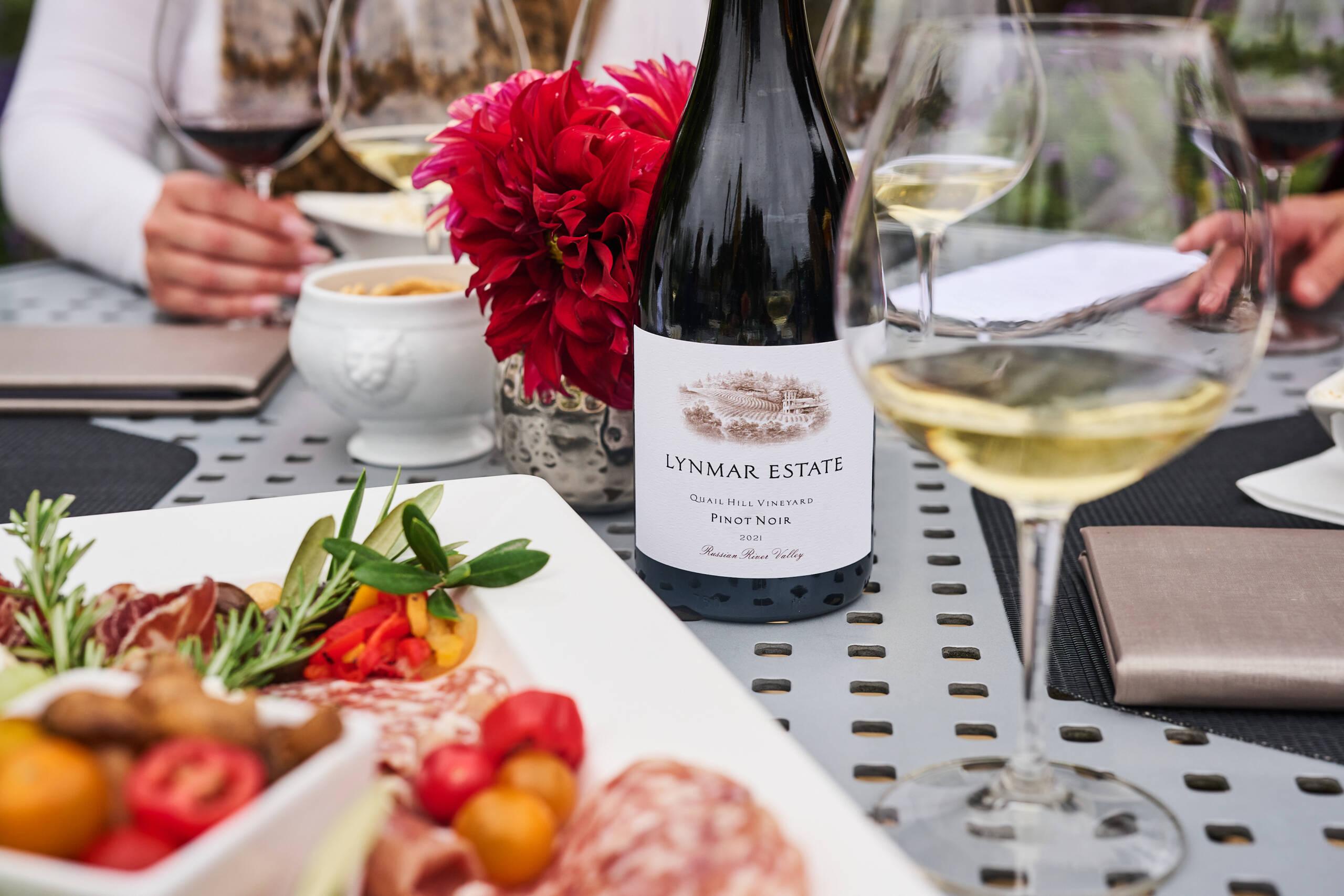
The Science of Fat and Acid: Why Chardonnay Cuts Through Creamy Risotto
At a Glance: The Ultimate Pairing for Creamy Risotto
- The Best Wine Pairing: Cool-climate Russian River Valley Chardonnay — specifically from Lynmar Estate’s Quail Hill Vineyard, Sebastopol, CA.
- The Chemistry: The naturally high malic and tartaric acids in Lynmar’s estate Chardonnay — preserved by cold Pacific fog rolling nightly through the Petaluma Gap — act as a structural palate cleanser, physically slicing through the dish’s dense, starchy, dairy-rich fats.
- The Textural Bridge: The creamy mouthfeel of the risotto mirrors the silky texture of a Chardonnay aged on its lees in French oak — creating a luxurious “texture-on-texture” experience that makes the wine and dish feel like one seamless sensation.
- The Source: Executive Chef David Frakes draws from Lynmar’s organically farmed culinary gardens at Quail Hill Vineyard — harvesting estate-grown spring English peas, Meyer lemon, and garden herbs — to build a precise aromatic bridge to the citrus and orchard-fruit notes of the wine in your glass.
- The Experience: Discover the science of flavor through our intimate, multi-course Collector’s Lunch Pairing — served tableside overlooking Quail Hill Vineyard and widely regarded as one of the finest food and wine experiences in Sonoma County.
Why is Chardonnay the Best Wine Pairing for Risotto?
The definitive wine pairing for a classic, creamy risotto is a cool-climate Russian River Valley Chardonnay. Risotto is an inherently rich, heavy dish that coats the palate with slow-released starches, butter, and aged cheese. To balance this heavy, palate-coating weight, you require a wine with genuine structural backbone — specifically, high natural acidity. Unlike the aggressively buttery, over-oaked Chardonnays produced in warmer regions — which only add more cloying weight to an already rich dish — a finely crafted, cool-climate Chardonnay offers a spine of bright acidity (with notes of lemon curd, green apple, and wet stone) that slices cleanly through the dairy fat, refreshing your palate after every single bite and elevating the meal from satisfying to extraordinary.
At Lynmar Estate, our Quail Hill Vineyard Chardonnay is grown across four distinct Chardonnay blocks planted in the cooler pockets of Quail Hill’s undulating slopes — all on Goldridge soils — using Old Wente and Rued clones prized for their vibrant aromatics and naturally elevated acidity. The 2021 Quail Hill Vineyard Chardonnay carries a total acidity of 7.6 g/L, one of the clearest expressions of why cool-climate farming is not a marketing term, but a measurable, palate-transforming reality. This is the precise structural quality that makes it so devastating — in the best possible way — against a bowl of perfectly made risotto.
Our Authority: Elevating the Sonoma Culinary Experience
At Lynmar Estate, we believe that world-class luxury hospitality is rooted in agricultural truth and culinary science. For over 50 years, we have sustainably farmed the ancient Goldridge and Sebastopol Sandy Loam soils of our Quail Hill Vineyard in Sebastopol — originally planted in 1971 — crafting critically acclaimed, terroir-driven Russian River Valley Pinot Noir and Chardonnay. But we are not simply winemakers; we are designers of holistic sensory experiences.
Winemaker and General Manager Pete Soergel — a third-generation farmer, a veteran of Kosta Browne and Landmark Vineyards, and one of California’s most quietly acclaimed Chardonnay makers — conducts as many as 90 small-lot fermentations each vintage across Lynmar’s four estate vineyards. Each decision, from picking date to cooperage selection, is driven entirely by what each individual lot of fruit naturally offers. The result is a Chardonnay of uncommon precision and honesty — one that brings exactly the structural acidity and textural elegance that this pairing demands.
Under the expert culinary direction of Executive Chef David Frakes — at the heart of Lynmar’s hospitality program since 2011 — our culinary program transcends the standard wine country offering of pre-packaged cheese and crackers. Every menu at Lynmar begins with the wines, allowing their character, balance, and sense of place to guide what appears on the plate. Chef David draws from organically farmed culinary gardens, orchards, and perennial herb plantings located steps from the kitchen at Quail Hill, using estate-grown botanicals to create precise aromatic bridges between the food and the wine. We focus on context over recipes — empowering our guests to understand not just what pairs well, but why it works so profoundly.
The Anatomy of the Dish: The Weight of Risotto
To truly understand the magic of food and wine pairing, one must first deconstruct the mechanics and chemistry of the food. Risotto is a marvel of traditional Italian culinary technique, relying on the precise manipulation of grain starches — rather than heavy cream — to achieve its signature, velvety texture.
The process depends on high-starch, short-grain rice, such as Arborio or Carnaroli. As hot broth is slowly ladled into the pan, the constant stirring creates mechanical friction, forcing the rice grains to release amylopectin — a highly branched starch — into the cooking liquid, forming a natural, dense suspension. The dish is then finished off the heat with a technique called mantecatura: the vigorous whipping of cold butter and Parmigiano-Reggiano directly into the hot rice.
This specific technique creates a dish that is profoundly heavy in both complex carbohydrates and lipids. The resulting flavor profile is earthy, salty, and intensely rich. Pair this dish with the wrong wine and the experience quickly becomes monotonous, overwhelmingly heavy, and fatiguing to the senses. Pair it with the right one, and the combination becomes greater than the sum of its parts — the exact standard we hold ourselves to at Lynmar in everything we grow, make, and serve.
The Chemistry of the Pairing: The Blade of Acidity
Great food and wine pairings are not subjective accidents. They are born from the chemical interaction between what is on the plate and what is in the glass. When it comes to rich foods, acidity is the sommelier’s most powerful tool. Here is why a Lynmar Estate Chardonnay — grown in the cool, fog-drenched soils of Quail Hill — is the definitive scientific counterbalance to creamy risotto.
1. The Mechanics of Acid Cleansing the Palate
When you eat a spoonful of proper risotto, the emulsion of butter, cheese, and starch aggressively coats the taste receptors on your tongue. If you follow it with a low-acid wine — a warm-climate, flabby white or a heavy, tannic red — the fat acts as a literal barrier. The wine tastes dull, and the dish begins to feel uncomfortably heavy.
Quail Hill Vineyard sits at the convergence of three distinct ecosystems, bordered by the Laguna de Santa Rosa — a 22-mile sanctuary of creeks, marshes, and wetlands that defines the eastern edge of the vineyard. Pacific fog pushes through the Petaluma Gap each evening, dropping temperatures dramatically after warm, sun-filled days. As Anisya Fritz has written of this daily cycle: the cool, nighttime fog slows the grape’s natural respiratory system, “preserving acidity and allowing the grapes to reap the benefits of a good night’s rest.” This diurnal tension is not poetic embellishment — it is the measurable reason our Chardonnay carries a total acidity of 7.6 g/L while maintaining ripeness and complexity.
Sensory studies on palate cleansers confirm that acidic beverages physically counteract the lubricating feel of dietary fats. When you sip our estate Chardonnay after a bite of risotto, that bright, crisp acidity acts as a chemical blade — cutting through the lipid coating on your palate, washing away the heavy dairy fats, and refreshing your mouth entirely. The interplay creates an addictive cycle: the wine makes you crave another bite of food, and the food makes you crave another sip of wine.
(Curious about how red wines handle rich fats and proteins? Read our previous guide: The Science of Flavor: The Best Wine Pairing for Duck Confit.)
2. Texture Matching: The Magic of French Oak and Lees Aging
While acidity provides a contrasting balance to the fat, the very best food and wine pairings also deploy complementary elements. We want the acid to cut the fat — but we also want the mouthfeel of the wine to match the elegance and velvet of the dish.
Lynmar’s flagship Quail Hill Vineyard Chardonnay is aged for 14 months in French oak barrels at 30% new oak — a deliberate, restrained hand that imparts gentle toasted complexity and warm spice without burying the wine’s natural freshness or citrus vitality. This aging process, paired with sur lie contact (the wine resting on its spent yeast cells, releasing mannoproteins into the liquid), builds a rich, silky mouthfeel that is entirely distinct from heavy-handed butteriness. According to GuildSomm’s winemaking resources, these mannoproteins are specifically responsible for the sensation of roundness, weight, and creaminess in the finish — without added oak or malolactic manipulation.
The result is precisely what this pairing demands. When you sip a sur lie-aged Quail Hill Chardonnay alongside a velvety risotto, the liquid feels just as luxurious and weightless as the perfectly cooked rice, creating a seamless “Texture-on-Texture” pairing that is as intellectually satisfying as it is sensory.
Sourcing from the Soil: The Lynmar Garden Connection
At Lynmar Estate, our philosophy of “Sensory Immersion” — shaped by resident proprietors Lynn and Anisya Fritz over decades of living and farming at Quail Hill — holds that the harmony between food and wine must begin in the soil. The vibrant landscape you walk through when you visit Lynmar is not purely ornamental; it is a fully functional, thriving agricultural ecosystem that feeds the kitchen every single day.
Quail Hill Vineyard’s organically farmed culinary gardens grow native and heirloom varieties of flowers, vegetables, herbs, edible flowers, and fruit — all chosen to support pollinators, beneficial insects, butterflies, and birds, and to supply Chef David with the freshest possible ingredients grown in the exact same terroir as the vines. The estate is Certified Bee Friendly, maintains Certified Beneficial Insectaries, and supports 22 barn owl boxes placed at over one per two acres — a living, breathing agricultural system that enriches both the flavor of the wine and the integrity of every dish.
When Chef David designs a risotto to pair with a specific vintage of our Quail Hill Chardonnay, the ingredients are sourced directly from these gardens. Because our Chardonnay — built on Old Wente and Rued clones from cool, Goldridge-soil blocks — frequently exhibits tasting notes of fresh fennel, green apple, honeysuckle, nectarine, and lemon zest, Chef David walks into the garden to harvest botanicals that mirror those precise aromatic traits. A spring risotto at Lynmar might feature vibrant, estate-grown English peas to echo the wine’s fresh, green energy, finished with freshly grated zest from our estate Meyer lemon trees or a touch of garden tarragon to amplify the wine’s bright citrus character.
By utilizing produce grown in the same Goldridge soils and cooled by the same coastal fog as our grapevines — and pollinated by the same bees that move between the insectary plantings and the vineyard rows — the culinary team creates an invisible, unbreakable thread between the plate and the glass. As Pete Soergel says, “We grow the grapes, make the wines, and pair them with seasonal foods we grow in our own gardens. Everything is connected by the same visions and values.” This is regenerative, farm-to-table hospitality at its most genuine — and most delicious.
Context Over Recipes: Designing Your Sonoma Itinerary
A recipe tells you what to do. Understanding the science of fat and acid gives you a culinary awakening that changes how you drink and eat for the rest of your life. When you sit down for a luxury food and wine pairing at Lynmar Estate, the environment, pacing, and depth of context are just as vital to the experience as the food itself.
If you are planning a wine tasting trip to Sonoma County, you are likely looking for something more than a crowded bar and a poured flight. According to Sonoma County Tourism, discerning travelers increasingly seek destinations that offer “Quiet Luxury” — environments where the pace is unhurried, the vineyard views are uninterrupted, and the hospitality is substantive and genuinely educational.
Lynmar Estate is exactly that place. Our Collector’s Lunch Pairing — an intimate, multi-course, tableside experience at Quail Hill Vineyard, led by Chef David Frakes and his culinary team alongside Winemaker Pete Soergel’s estate wines — is widely regarded as one of the finest food and wine offerings in Sonoma County. To help you plan the perfect trip, be sure to read our upcoming guide: The Top 5 Culinary and Wine Tasting Visits in Sonoma.
We invite you to experience this culinary chemistry firsthand. Join us for a seated pairing on our terrace, overlooking the very gardens and vineyards that produced the meal in front of you — surrounded by hummingbirds, bees, and the rolling beauty of Quail Hill. Whether you are analyzing the bright tension of our Chardonnay against a creamy garden risotto, or exploring our feature on Pinot Noir and Mushrooms: Analyzing the ‘Earth-on-Earth’ Pairing, a visit to Lynmar is a true immersion into the heart of the Russian River Valley. Reserve your experience today.
Frequently Asked Questions (FAQ)
Why does Chardonnay pair so well with risotto? A cool-climate Chardonnay pairs beautifully with risotto because its high natural acidity acts as a physiological palate cleanser. The bright, crisp malic and tartaric acids — preserved by the fog-driven diurnal temperature shifts of the Russian River Valley — chemically cut through the heavy, starch-and-dairy-rich fats of the risotto, preventing the dish from feeling too heavy and refreshing your palate with every sip. At Lynmar, our Quail Hill Vineyard Chardonnay carries a total acidity of 7.6 g/L, making this chemistry especially vivid and satisfying.
Does an oaky, buttery Chardonnay work with risotto? Generally, no. An aggressively oaked, warm-climate Chardonnay that undergoes heavy malolactic fermentation — producing that pronounced “butter” flavor — lacks the necessary acidity to cleanse the palate. Pairing a heavy, buttery wine with a heavy, buttery dish creates a cloying, fatiguing experience. At Lynmar, our Quail Hill Vineyard Chardonnay uses a restrained 30% new French oak to build texture and spice without suppressing the natural acidity that makes this pairing work.
What is sur lie aging, and why does it matter for food pairing? Sur lie is a French winemaking term meaning the wine is aged on its fine lees — the spent yeast cells after fermentation. As the lees break down, they release mannoproteins into the liquid, giving the wine a silky, luxurious, and slightly creamy mouthfeel without adding actual heaviness or oak-driven butteriness. At Lynmar, our Quail Hill Vineyard Chardonnay spends 14 months in French oak developing this precise texture — one that creates a seamless “Texture-on-Texture” harmony with the velvety mouthfeel of a perfectly made risotto.
How does Lynmar Estate integrate its gardens into its Chardonnay pairings? Lynmar Estate’s culinary program, led by Executive Chef David Frakes since 2011, uses hyper-local, estate-grown produce to build exact aromatic bridges to the wine in the glass. Because our Quail Hill Chardonnay — grown from Old Wente and Rued clones in Goldridge soil blocks — regularly exhibits notes of fresh fennel, green apple, honeysuckle, nectarine, and lemon zest, Chef David harvests estate Meyer lemons, spring English peas, and specific herbs from our Certified Bee Friendly culinary gardens to compose dishes that mirror the wine’s flavor profile with remarkable precision.
Do I need a reservation for a food and wine pairing at Lynmar Estate? Yes. To maintain our standard of Quiet Luxury and provide guests with an unhurried, educational, and genuinely exceptional tableside experience, all wine and culinary pairings at Lynmar Estate require a reservation.
Make your reservation today for our Collector’s Lunch Pairing.
Lynmar Estate is a luxury, resident-proprietor winery located at 3909 Frei Road in Sebastopol, CA, in the heart of the Russian River Valley. Specializing in estate-grown Pinot Noir and Chardonnay from four estate vineyards — Quail Hill, Susanna’s, Adam’s, and Hessel Station — Lynmar is recognized as one of wine country’s most exceptional destinations for culinary and wine hospitality. The estate is Certified California Sustainable Winegrowing, Certified Bee Friendly, and dry-farms the majority of its 80 planted acres. All four vineyards are currently in the three-year CCOF Organic Certification process.