
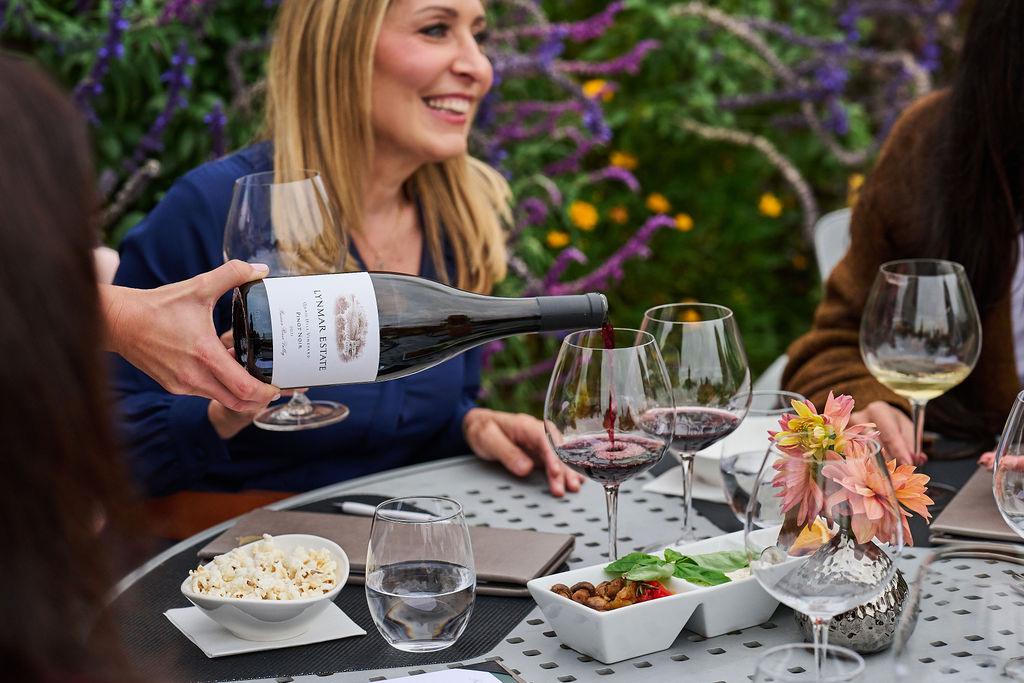
Pinot Noir and Mushrooms: Analyzing the ‘Earth-on-Earth’ Pairing
At a Glance: The Ultimate Pairing for Mushrooms
- The Best Wine Pairing: Cool-climate Russian River Valley Pinot Noir — specifically from Lynmar Estate’s Quail Hill Vineyard in Sebastopol, CA.
- The Chemistry: The intense umami compounds in mushrooms interact destructively with high-tannin red wines, making Pinot Noir’s naturally thin-skinned, silk-like, low-tannin structure the perfect physiological counterpart for this ingredient.
- The Flavor Bridge: As Lynmar’s estate Pinot Noir evolves in the bottle, its primary fruit gives way to deeply savory sous-bois (forest floor) aromas of damp earth, dried herbs, and black tea — creating a seamless “Earth-on-Earth” aromatic mirror with the fungi that is one of wine’s most profound and naturally occurring pairings.
- The Source: Executive Chef David Frakes draws from Lynmar’s organically farmed culinary gardens at Quail Hill Vineyard — harvesting fresh winter thyme, rosemary, sage, and estate-grown garlic — to bridge the earthy umami of the dish directly to the savory complexity of the wine.
- The Experience: Discover the science of umami and terroir through our intimate, multi-course Collector’s Lunch Pairing — served tableside overlooking Quail Hill Vineyard and widely regarded as one of the finest food and wine experiences in all of Sonoma County.
Why is Pinot Noir the Best Wine Pairing for Mushrooms?
The definitive wine pairing for a mushroom-focused dish — whether a wild chanterelle tart, a roasted maitake with estate herbs, or a deep porcini-dusted preparation — is a cool-climate Russian River Valley Pinot Noir. Mushrooms are defined by their deep, earthy flavors and intense concentration of umami, the fifth taste. To achieve harmony on the palate, you require a red wine with naturally low tannins, because the umami compounds in mushrooms will make highly tannic wines taste metallic and harsh. Unlike the heavy, astringent structure of a Cabernet Sauvignon, a finely crafted Pinot Noir offers a silk-like texture that genuinely embraces the mushroom rather than fighting it. And in the case of a Quail Hill Vineyard Pinot Noir — shaped by 50 years of farming in Sebastopol Sandy Loam and Goldridge soils, and built from 14 distinct Pinot Noir clones across 16 unique blocks — the wine also possesses deeply savory, evolved secondary aromas of black tea, fresh herbs, and forest floor that are not coincidentally similar to the mushroom’s flavor profile. They are its mirror image.
Our Authority: Elevating the Sonoma Culinary Experience
At Lynmar Estate, we believe that world-class luxury hospitality is rooted in agricultural truth and culinary science. For over 50 years, we have sustainably farmed the ancient Sebastopol Sandy Loam and Goldridge soils of Quail Hill Vineyard in Sebastopol — the same soils that, due to their natural nutrient poverty, force our vines to struggle, producing smaller berries, looser clusters, and the concentrated, terroir-expressive flavors that make this pairing so extraordinary. We are not simply winemakers; we are designers of holistic sensory experiences.
Winemaker and General Manager Pete Soergel — a third-generation farmer, a veteran of Kosta Browne and Landmark Vineyards, and one of California’s most quietly acclaimed Pinot Noir makers — performs as many as 90 small-lot fermentations each vintage across Lynmar’s four estate vineyards. The 2021 Quail Hill Vineyard Pinot Noir, a showcase of all 14 Pinot Noir clones grown across 16 utterly distinct blocks, earned 94 Points from both Wine Enthusiast (Cellar Selection) and Wine Spectator — a testament to the depth and consistency of what Quail Hill produces year after year.
Under the expert culinary direction of Executive Chef David Frakes — the heart of Lynmar’s hospitality program since 2011 — our culinary program transcends the standard wine country offering. Each menu begins with the wines, allowing their character, balance, and sense of place to guide every element of the plate. We focus on context over recipes, empowering our guests to understand not just what pairs well, but precisely why — and in the case of Pinot Noir and mushrooms, the science is as thrilling as the flavor.
The Anatomy of the Dish: The Power of Umami
To master the art of food and wine pairing, one must first deconstruct the biological and chemical makeup of the ingredient. The magic of mushrooms lies entirely in a specific taste receptor: Umami.
Identified by Japanese chemist Kikunae Ikeda in 1908, umami is the fifth basic taste, joining sweet, sour, salty, and bitter. According to the Umami Information Center, this deeply savory sensation is caused by high levels of naturally occurring glutamate — an amino acid — and ribonucleotides found abundantly in fungi.
When mushrooms are cooked — especially when roasted, sautéed in butter, or dehydrated — these glutamates concentrate, creating a deeply savory, almost meaty flavor profile despite being entirely plant-based. At Lynmar, Chef David is particularly drawn to locally sourced and estate-paired varieties: maitake for their lacy, dramatic texture; chanterelles for their golden, fruity earthiness; and dried porcini for their concentrated, almost brooding savory intensity. Each variety brings a different register of umami to the dish — and each finds its most complete expression alongside a glass of Quail Hill Pinot Noir.
This intense concentration of glutamate dictates the entire architecture of the pairing. It demands a wine that can embrace extreme savory notes without aggressively fighting them — one whose own aromatic evolution is heading in the same earthy direction.
The Chemistry of the Pairing: Tannins, Umami, and Terroir
Great food and wine pairings are not subjective accidents; they rely on the physiological interaction between what is on the plate and what is in the glass. When it comes to umami-rich foods, the sommelier’s greatest focus is on tannin management and aromatic bridging. Here is the science behind why a Lynmar Estate Quail Hill Pinot Noir is the ultimate match.
1. Managing Tannins: The Umami Clash
Tannins are the naturally occurring phenolic compounds found in grape skins, seeds, and stems that give red wine its astringent, mouth-drying quality. A common pairing mistake is assuming that a “meaty” tasting dish — like roasted portobello mushrooms or a porcini-dusted preparation — requires a heavy, “meaty” red wine like Cabernet Sauvignon or Syrah.
Biochemically, this is a disaster. According to wine sensory science, umami significantly increases the perception of bitterness and astringency in wine while simultaneously decreasing the perception of fruit, sweetness, and body. Pair a high-tannin wine with a high-umami mushroom dish, and the wine instantly tastes harsh, metallic, and stripped of its elegance.
Pinot Noir grapes have famously thin skins, producing a wine that is naturally very low in tannins. At Quail Hill, this characteristic is magnified by the nutrient-poor Sebastopol Sandy Loam soils, which stress the vines into producing smaller berries with a higher skin-to-juice ratio — yet because those skins are inherently thin, the resulting tannins are fine-grained and silk-like rather than grippy or astringent. This gentle structure ensures the wine gracefully embraces the savory glutamates of the mushroom rather than clashing with them.
The 2021 Quail Hill Vineyard Pinot Noir — aged 14 months in French oak barrels at 31% new oak — offers aromas of Bing cherry, fresh-cut cedar, and wild berry, with flavors of black tea, brambly fruits, and fresh herbs. It is precisely the black tea and fresh herb register of that flavor profile that creates the bridge. The wine is heading in the same earthy, savory direction as the mushrooms long before the two ever meet on the table.
(Curious about how acidity manages richness in white wine pairings? Read our companion guide: The Science of Fat and Acid: Why Chardonnay Cuts Through Creamy Risotto.)
2. The “Earth-on-Earth” Aromatic Bridge
While structure — low tannin and measured acidity — dictates how a pairing feels in the mouth, aromatics dictate how it tastes. The most profound food and wine pairings occur when the primary aromas of the food mirror the evolved tertiary aromas of the wine.
Pinot Noir is globally celebrated for its complex aromatic evolution over time. At Lynmar, this evolution is visible from block to block: the Swan Clone Old Vines block — originally planted in 1974 using bud wood sourced from Joseph Swan himself, and once sold to Merry Edwards at Matanzas Creek and Tony Soter at Étude — produces wines of pure red fruit character and remarkable grace, with a slow-developing earthy depth. The Dijon clones 667 and 777 in Block 10 bring the intensity and structure of classic Russian River Valley terroir. The Bliss Block, organically farmed and harvested using massal selection from 7 clones planted together in the same rows, produces wines of extraordinary completeness — approachable yet complex, earthy yet bright.
As any of these wines age in the bottle, their primary fruit flavors — Bing cherry, wild berry, fresh raspberry — give way to deeply savory characteristics the wine world describes with the French term sous-bois: undergrowth, forest floor, damp earth, dried autumn leaves, black tea, and, most pointedly, wild mushroom. When you pair an earthy ingredient with a wine whose own natural aromatic evolution leads it toward the same forest floor, you create an “Earth-on-Earth” pairing. The savory notes in the glass amplify the umami in the dish, and the dish in turn draws out the tertiary complexity of the wine, creating an echoing flavor experience that is exponentially greater than the sum of its parts.
Sourcing from the Soil: The Lynmar Garden Connection
At Lynmar Estate, our philosophy of “Sensory Immersion” — shaped by resident proprietors Lynn and Anisya Fritz across more than four decades of living and farming at Quail Hill — holds that the harmony between food and wine must begin in the soil. The beautiful, living landscape you walk through when you visit Lynmar is not purely ornamental; it is a fully functional, thriving agricultural ecosystem that feeds the kitchen and the vineyard in equal measure every single day.
Quail Hill Vineyard’s organically farmed culinary gardens grow native and heirloom varieties of flowers, vegetables, herbs, and edible botanicals — chosen to support pollinators, beneficial insects, butterflies, and birds, and to supply Chef David with hyper-local ingredients grown in the same terroir as the vines. The estate is Certified Bee Friendly, maintains Certified Beneficial Insectaries, and supports 22 barn owl boxes placed throughout the property — a living, regenerative agricultural system that enriches both the flavor of the wine and the integrity of every dish.
When Chef David designs a mushroom preparation to pair with a specific vintage of our Quail Hill Pinot Noir, the bridging ingredients are drawn directly from these gardens. A mushroom dish is rarely just mushrooms. If a particular block of our Pinot Noir is exhibiting prominent notes of baking spice, cola, fresh herbs, and dried black tea — as the 2021 Quail Hill Vineyard Pinot Noir does — Chef David walks into the garden to harvest winter thyme, rosemary, sage, or estate-grown garlic. He might roast locally sourced maitake mushrooms in a cast-iron with these specific botanicals, allowing the herbs to char gently and mirror the cedar and brambly-fruit complexity of the wine.
By utilizing botanicals grown in the same Sebastopol Sandy Loam and cooled by the same coastal fog as our grapevines — and pollinated by the same bees that move through the insectary plantings and vineyard rows alike — the culinary team creates an invisible, unbreakable thread between the plate and the glass. As Pete Soergel observes: “We grow the grapes, make the wines, and we pair them with seasonal foods we grow in our own gardens. Everything is connected by the same visions and values.” This is regenerative, farm-to-table hospitality at its most genuine and most profoundly delicious.
Context Over Recipes: Designing Your Sonoma Itinerary
A recipe simply provides instructions. Understanding the science of umami, tannin, and terroir gives you a culinary awakening that permanently changes how you drink and eat. When you sit down for a luxury food-and-wine pairing at Lynmar Estate, the environment, pacing, and depth of context are just as vital to the experience as the food itself.
If you are planning a wine tasting trip to Sonoma County, you are likely seeking something far more meaningful than a crowded standing bar. According to Sonoma County Tourism, discerning travelers increasingly seek out destinations that offer “Quiet Luxury” — environments where the pace is unhurried, the vineyard views are uninterrupted, and the hospitality is genuinely substantive and educational.
Lynmar Estate is exactly that place. Our Collector’s Lunch Pairing — an intimate, multi-course, tableside experience at Quail Hill Vineyard led by Chef David Frakes and framed by Pete Soergel’s estate wines — is widely regarded as one of the finest food and wine offerings in Sonoma County. To help you build the perfect itinerary, be sure to read our upcoming definitive guide: The Top 5 Culinary and Wine Tasting Visits in Sonoma.
We invite you to experience this culinary chemistry firsthand. Join us for a seated pairing on our terrace, overlooking the very gardens and vineyards that produced the meal in front of you — surrounded by hummingbirds, bees, and the gently rolling beauty of Quail Hill. Whether you are exploring the “Earth-on-Earth” synergy of Pinot Noir and mushrooms, or tracing the structural tension explored in our guide to The Best Wine Pairing for Duck Confit, a visit to Lynmar Estate is a true sensory immersion into the heart of the Russian River Valley. Reserve your experience today.
Frequently Asked Questions (FAQ)
Why does Pinot Noir pair so perfectly with mushrooms? Pinot Noir is the ideal match for mushrooms for two scientific reasons. First, its naturally thin skins — producing a wine low in tannins — prevent the savory umami of the mushrooms from making the wine taste metallic or bitter. Second, Pinot Noir naturally develops sous-bois (forest floor) aromas as it evolves — including dried earth, black tea, and wild mushroom — perfectly mirroring the earthy flavor profile of the fungi in an “Earth-on-Earth” pairing. At Lynmar, this is especially vivid in our Quail Hill Vineyard Pinot Noir, where block-specific wines from the Old Vines, Block 10, and Bliss Block each bring their own register of earthy complexity to the table.
Can I pair Cabernet Sauvignon with mushroom dishes? Generally, it is not recommended unless the dish features a heavy red meat alongside the mushrooms. Mushrooms are incredibly high in umami. When high-umami foods interact with the high tannins found in Cabernet Sauvignon, a chemical clash occurs that strips the wine of its fruit flavors, resulting in a harsh, metallic, and bitter experience on the palate. The thin-skinned structure of Pinot Noir is specifically what makes it physiologically suited for mushroom pairings where Cabernet fails.
What is sous-boisin wine tasting? Sous-bois is a French wine tasting term that translates to “undergrowth” or “forest floor.” It describes the complex, earthy, savory tertiary aromas — including damp earth, dried leaves, truffles, black tea, and wild mushrooms — that develop in high-quality Pinot Noir as it ages in the bottle. At Lynmar Estate, the sous-bois character of our Quail Hill Vineyard Pinot Noir is a direct expression of our Sebastopol Sandy Loam soils, our dry-farming philosophy, and the slow, fog-driven ripening that preserves natural acidity and aromatic complexity across all 14 clones and 16 vineyard blocks.
How does Lynmar Estate integrate its gardens into its Pinot Noir pairings? Lynmar Estate’s culinary program, led by Executive Chef David Frakes since 2011, uses hyper-local, organically farmed estate produce to build exact aromatic bridges between the food and the wine. Because our Quail Hill Vineyard Pinot Noir regularly exhibits flavors of black tea, brambly fruits, and fresh herbs, Chef David harvests estate-grown winter thyme, rosemary, sage, and garlic from our Certified Bee Friendly culinary gardens to roast alongside the mushrooms — linking the earthiness of the dish directly to the sous-bois complexity of the glass.
Do I need a reservation for a food and wine pairing at Lynmar Estate? Yes. To maintain our standard of Quiet Luxury and provide guests with an unhurried, educational, and genuinely exceptional tableside experience, all wine and culinary pairings at Lynmar Estate require a reservation.
Make your reservation today for our Collector’s Lunch Pairing.
Lynmar Estate is a luxury, resident-proprietor winery located at 3909 Frei Road in Sebastopol, CA, in the heart of the Russian River Valley. Specializing in estate-grown Pinot Noir and Chardonnay from four estate vineyards — Quail Hill, Susanna’s, Adam’s, and Hessel Station — Lynmar is recognized as one of wine country’s most exceptional destinations for culinary and wine hospitality. The estate is Certified California Sustainable Winegrowing, Certified Bee Friendly, and dry-farms the majority of its 80 planted acres. All four vineyards are currently in the three-year CCOF Organic Certification process.