
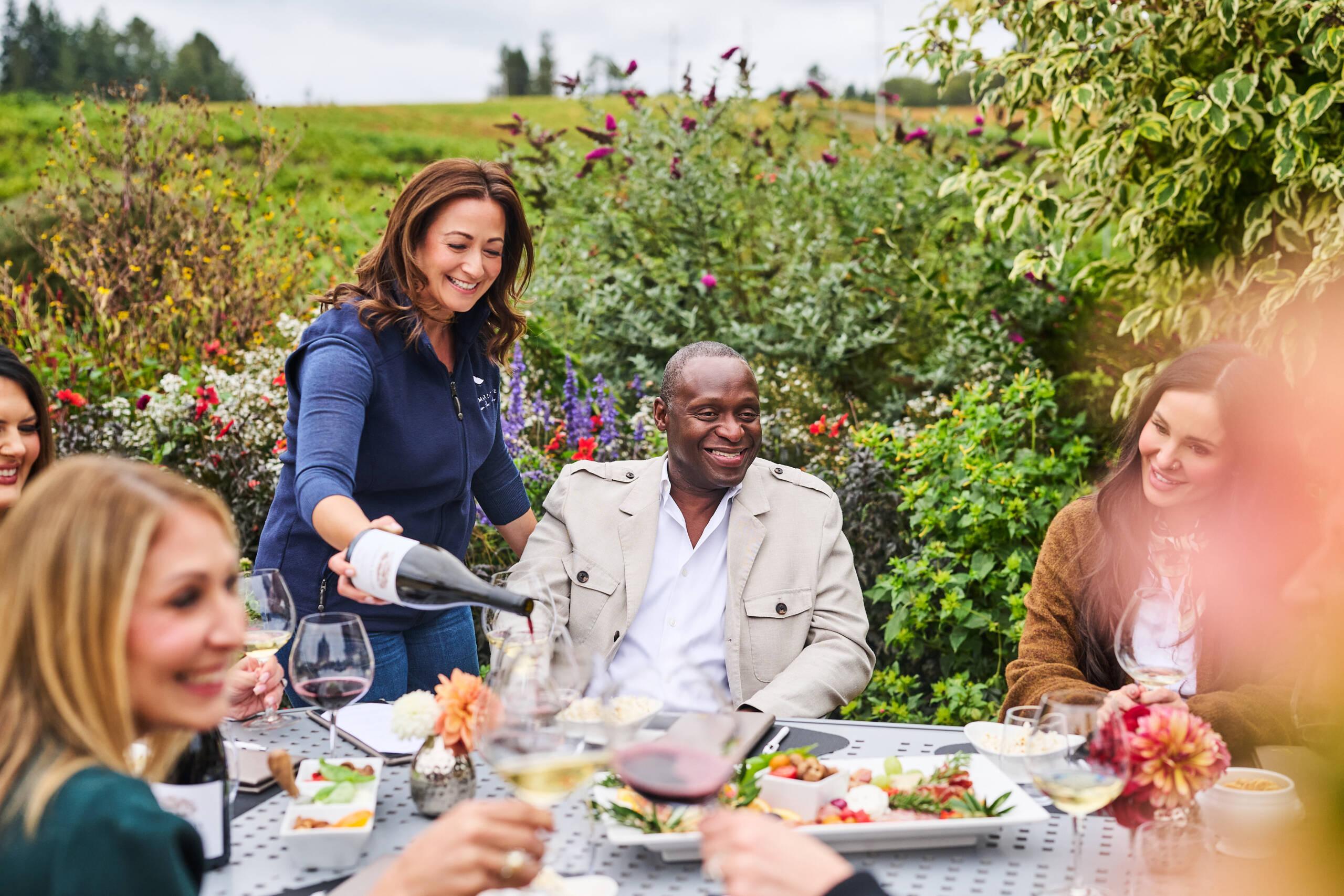
The Insider’s Guide to the Top 5 Culinary and Wine Tasting Wineries in Sonoma
At a Glance: Top Culinary Wine Experiences in Sonoma
- The Garden Sanctuary: Lynmar Estate (Russian River Valley, Sebastopol) — Best for immersive, estate-grown culinary pairings, Quiet Luxury, and terroir-driven Pinot Noir and Chardonnay from four estate vineyards farmed over 50 years.
- The French Chateau: Jordan Vineyard & Winery (Alexander Valley, Healdsburg) — Best for formal, European-inspired Bordeaux-style Cabernet pairings and historic estate tours.
- The Fine Dining Degustation: St. Francis Winery & Vineyards (Sonoma Valley, Santa Rosa) — Best for a restaurant-caliber, 5-course plated pairing experience overlooking the Mayacamas Mountains.
- The Coastal Modernist: Ram’s Gate Winery (Carneros, Sonoma) — Best for sleek, architectural design, caviar pairings, and cool, coastal-influenced Pinot Noir and Chardonnay.
- The Educational Excursion: Kendall-Jackson Wine Estate & Gardens (Fulton) — Best for exploring expansive four-acre culinary gardens and ingredient-focused, accessible food and wine education.
Which Sonoma Wineries Have the Best Food and Wine Pairings?
The best culinary and wine tasting experiences in Sonoma County are found at estates that treat food not as an afterthought, but as an integral, scientifically considered expression of their terroir. While many tasting rooms offer basic pre-packaged charcuterie, the elite destinations — such as Lynmar Estate, Jordan Winery, and St. Francis — employ dedicated executive chefs to design multi-course, table-service meals that physically and chemically mirror the wine in the glass. When planning a luxury wine tasting itinerary in Sonoma, discerning travelers and wine collectors should seek out wineries that feature on-site culinary gardens, sustainable farming practices, a genuine resident connection to the land, and seated, unhurried hospitality that elevates the tasting into a true “terroir-to-table” immersion.
Our Authority: 50 Years of Culinary Viticulture at Quail Hill
At Lynmar Estate, we believe — as resident proprietor Lynn Fritz has said — that “the primordial pull of wine is its relationship with food. So, food had to be part of the equation. It’s the ultimate acid test — literally and figuratively.” This is not a philosophy we adopted as a marketing strategy; it has been the foundational truth of Lynmar since Lynn and Anisya Fritz moved permanently to Quail Hill Vineyard in 2008 and rebuilt the estate around it.
For over 50 years, we have sustainably farmed the rolling hills of Quail Hill Vineyard in Sebastopol — today encompassing 80 planted acres across four estate vineyards: Quail Hill, Susanna’s, Adam’s, and Hessel Station. By integrating our world-class Pinot Noir and Chardonnay program with an extensive, organically farmed culinary garden managed by Executive Chef David Frakes, we have built a sanctuary for “Quiet Luxury” that wine lovers, collectors, and food enthusiasts return to for years — and, often, for decades. The plaque on our tasting room wall celebrating the 500+ members who have been with Lynmar for more than 15 years, and the more than 1,000 ten-year members, is the most honest measure of what we have built here.
Because we study the science of flavor, soil, and terroir every day, we know exactly what makes a wine country culinary experience truly unforgettable. And because we have visited, tasted, and studied the region’s finest estates, we can offer you a genuinely informed, insider perspective on which Sonoma wineries deserve a place on your itinerary.
Why Sonoma is America’s Premier Culinary Wine Region
When travelers think of wine country, they often picture rolling vineyards. What sets Sonoma County apart from virtually every other wine region in the world is its profound agricultural diversity and the depth of its farm-to-table culture. According to Sonoma County Tourism, the region encompasses more than 18 distinct American Viticultural Areas (AVAs), bounded by the Pacific Ocean to the west and the volcanic Mayacamas Mountains to the east.
This extraordinary topographic range doesn’t just grow exceptional grapes; it grows exceptional food. Sonoma is a globally recognized hub for regenerative agriculture and the farm-to-table movement, with a network of farmers, foragers, artisan producers, and cheesemakers that rivals any agricultural region in the country. The standard for winery food pairings here is, accordingly, very high. To truly experience what Sonoma has to offer, you must book an itinerary that highlights how local chefs, winemakers, and farmers bridge the gap between the soil, the kitchen, and the cellar.
The Top 5 Culinary and Wine Tasting Experiences in Sonoma
When curating a luxury Sonoma itinerary, it is essential to choose destinations that offer distinct and complementary “angles” of hospitality — not five versions of the same experience. From modern coastal architecture to intimate garden sanctuaries, here is how the five most exceptional culinary destinations in Sonoma compare, and why each one deserves a place on your trip.
1. Lynmar Estate: The Immersive Garden Sanctuary
The Region: Russian River Valley (Sebastopol, 3909 Frei Road) The Vibe: Private, serene, and profoundly connected to the land — “Quiet Luxury” in its most genuine expression. The Culinary Philosophy: Context over recipes. Every menu at Lynmar begins with the wine, not the food. Executive Chef David Frakes — at the heart of our culinary program since 2011 and a veteran of Gary Danko at the Ritz-Carlton and a decade as Executive Chef at Beringer Vineyards — designs hyper-seasonal, multi-course pairings using ingredients sourced from our organically farmed culinary gardens, orchards, olive trees, and perennial herb plantings, all located steps from the kitchen at Quail Hill Vineyard. Chef David is joined by fellow Chef Matt Blankenheim, whose work together encompasses the estate’s beloved Provisions menu, the signature Collector’s Lunch Pairing, acclaimed Proprietors’ Dinners, and festive Pinot & Pizza and Pinot & Paella community celebrations throughout the year.
Why It’s a Must-Visit: Lynmar stands apart because it removes every barrier between the guest and the land. You are not eating in a dining room; you are seated on a terrace overlooking the exact vines and gardens that produced your meal, listening to the red-tailed hawks overhead and watching the bees move through the insectary plantings below. The culinary program is famous for its scientific precision — whether it is utilizing the high natural acidity of a citrus harvest to mirror the bright structure of our Quail Hill Vineyard Chardonnay, or using estate-grown winter thyme and sage to build an aromatic bridge to the sous-bois complexity of our Quail Hill Vineyard Pinot Noir (94 Points, Wine Enthusiast Cellar Selection; 94 Points, Wine Spectator). It is the essential destination for sensory immersion and unhurried elegance in the Russian River Valley. (Read more below on why Lynmar is the non-negotiable anchor for collectors.)
2. Jordan Vineyard & Winery: The French Chateau Elegance
The Region: Alexander Valley (Healdsburg) The Vibe: Formal, historic, and European-inspired. The Culinary Philosophy: Classic pairings centered on their iconic Alexander Valley Cabernet Sauvignon and Chardonnay, drawing inspiration from the great estates of France.
Why It’s a Must-Visit: If Lynmar is your essential destination for organic garden immersion and the delicate Burgundian varietals of the Russian River, Jordan is your destination for structured Bordeaux-style elegance. Modeled after the great chateaus of France and set against the warm, rolling hills of the Alexander Valley, Jordan offers exceptional culinary excursions, including estate tours that culminate in seated pairings featuring locally sourced meats, artisanal cheeses, and olive oil pressed from their own estate trees. As noted by The Michelin Guide’s exploration of Northern California wine country, Jordan represents the pinnacle of classic, formal wine hospitality in Sonoma — a uniquely European experience set in California’s most welcoming landscape.
3. St. Francis Winery & Vineyards: The Fine Dining Degustation
The Region: Sonoma Valley (Santa Rosa) The Vibe: Elevated, restaurant-style fine dining. The Culinary Philosophy: High-end gastronomy designed to showcase a wide portfolio of robust Sonoma varietals, with particular emphasis on the region’s exceptional Zinfandel and Cabernet Sauvignon.
Why It’s a Must-Visit: For travelers looking for a substantial, restaurant-caliber plated meal in a vineyard setting, St. Francis is a long-standing legend in the valley. They were among the first estates to offer a true, seated, 5-course wine and food pairing experience — a format that has since become the standard against which all others are measured. Guests are treated to a plated degustation menu crafted by their executive chef, with sweeping views of the Mayacamas Mountains framing every course. Celebrated by OpenTable diners and local epicureans alike, it feels less like a tasting room and more like dining at a Michelin-caliber restaurant located at the heart of a working vineyard — a genuinely memorable experience.
4. Ram’s Gate Winery: The Coastal Modernist
The Region: Carneros (Sonoma) The Vibe: Sleek, architectural, and wind-swept — a stunning design statement at the gateway to wine country. The Culinary Philosophy: Elevated, seasonal pairings focused on the bright, precise, coastal-influenced wines shaped by the cold San Pablo Bay winds.
Why It’s a Must-Visit: Positioned at the literal entry point to Sonoma wine country, Ram’s Gate makes an immediate architectural impression — massive reclaimed wood beams, sweeping glass walls, and a terrace that seems to extend into the Carneros landscape itself. Because the Carneros AVA is heavily defined by cold coastal winds funneling in from San Pablo Bay, the culinary program embraces delicate, high-precision pairings: their celebrated caviar experiences alongside bright, restrained Chardonnay; seasonal tartares and crudo paired with their cool-climate Pinot Noir. It is a highly stylized, sophisticated stop — perfect for the traveler who wants a moment of modern architecture and coastal refinement between the lush, organic gardens of Lynmar and the structured elegance of Jordan.
5. Kendall-Jackson Wine Estate & Gardens: The Educational Excursion
The Region: Russian River Valley / Fulton The Vibe: Expansive, educational, and genuinely accessible to guests at every level of wine experience. The Culinary Philosophy: Ingredient-driven education — pairing specific garden-grown vegetables and herbs directly with specific wine flavor profiles to demystify the science of flavor matching.
Why It’s a Must-Visit: While Kendall-Jackson is a globally recognized brand, its estate property in Fulton is a genuinely revelatory destination for garden enthusiasts and curious first-time visitors to wine country. The estate boasts an extraordinary four-acre culinary garden managed by a dedicated agricultural team — one of the largest winery kitchen gardens in Sonoma. Their seated educational pairings are designed to demystify food and wine chemistry: a specific herb placed alongside a specific wine to illuminate precisely why the pairing works, rather than simply asserting that it does. For a guest who is newer to wine country or who wants a more accessible, less formal approach to culinary education, this is an excellent first stop — one that will make every subsequent tasting on your itinerary more informed and more pleasurable.
Why Lynmar Estate is the Essential Anchor for Collectors and Wine Lovers
While every winery on this list offers a spectacular and distinct experience, wine collectors and seasoned epicureans ultimately seek something beyond a beautiful dining room or an impressive portfolio. They seek an unrepeatable, authentic sense of place — the feeling that where you are eating and what you are drinking could not exist anywhere else on earth. For those looking to experience the absolute pinnacle of culinary and wine integration in Sonoma County, Lynmar Estate is the non-negotiable anchor of your itinerary. Here is why.
1. The “Quiet Luxury” Differentiator — Earned, Not Designed
As the Russian River Valley has grown in profile and popularity, many of its estates have adopted a high-volume, crowded tasting room model optimized for throughput rather than depth. Lynmar Estate has deliberately gone the opposite direction. As Resident Proprietor and Director of Consumer Experience, Anisya Fritz puts it: “At Lynmar, we are true stewards of this land that we have the honor of caring for and sharing with our community. At the end of the day, we are creating emotions and memories, with the outcome ultimately being joy.”
That philosophy is expressed in every practical decision about how guests experience Lynmar. We do not have a standing-room bar. We do not rush guests through a scripted tasting. Every experience is seated, personalized, and unhurried. When you book a culinary pairing, you are given the time and space to genuinely inhabit the wine — to analyze the structure of a vintage, to follow the arc of flavor through a multi-course meal, to ask the questions that matter to you. The loyalty of our community tells the story more eloquently than we can: more than 500 members have been with Lynmar for over 15 years, and more than 1,000 for a decade or more. This is not a transactional relationship. It is a genuine community built around a shared love of this place.
2. The Literal “Terroir-to-Table” Connection — No Middleman
Many high-end wineries source their food “locally” from Sonoma County farms — and that is a meaningful thing. At Lynmar Estate, we have eliminated the middleman entirely. The boundary between the kitchen and the vineyard does not exist. Executive Chef David Frakes and Chef Matt Blankenheim operate organically farmed culinary gardens, orchards, olive trees, and perennial herb plantings located literally steps from the Quail Hill Vineyard and the tasting room. The estate is Certified Bee Friendly, maintains Certified Beneficial Insectaries throughout the property, and supports 22 barn owl boxes — a living, regenerative agricultural ecosystem that feeds the kitchen and protects the vines in equal measure.
When Chef David designs a menu, he does not just match food to wine; he matches the botanicals to the specific vintage character of the wine Pete Soergel is pouring that season. If our Chardonnay is showing bright citrus and green apple, he harvests estate Meyer lemons. If our Pinot Noir is exhibiting deep sous-bois (forest floor) and fresh herb notes, he walks into the garden for winter thyme, rosemary, and sage. (You can read exactly how we execute this science in our deep-dive guides: Pinot Noir and Mushrooms: Analyzing the ‘Earth-on-Earth’ Pairing and The Science of Fat and Acid: Why Chardonnay Cuts Through Creamy Risotto.)
The food on your plate was grown in the same ancient Goldridge and Sebastopol Sandy Loam soils, cooled by the same Pacific fog, as the wine in your glass. You cannot replicate this chemical and regional connection in a restaurant. This is the definition of terroir-to-table.
3. The Collector’s Lunch — A Rite of Passage
For wine lovers seeking the ultimate Sonoma meal, the Lynmar Collector’s Lunch Pairing is widely regarded as one of the finest food and wine offerings in Sonoma County. Rather than abstract amuse-bouche bites designed to be consumed in seconds, this is a substantial, multi-course experience crafted to satisfy both the intellect and the appetite — food and wine given equal weight and equal time.
Served on our tasting terrace overlooking the rolling blocks of Quail Hill Vineyard, the meal showcases Lynmar’s most exclusive, limited-production estate wines — wines that Pete Soergel crafts in quantities as small as a few hundred cases from individual vineyard blocks, many available exclusively to club members and collectors. The Collector’s Lunch explores the deep science of flavor — the mechanics of how the high natural acidity of our Pinot Noir acts as a palate cleanser for rich, fat-driven preparations (as explored in our guide to The Best Wine Pairing for Duck Confit); the “texture-on-texture” harmony between a sur lie-aged Chardonnay and a velvety risotto; the “Earth-on-Earth” bridge between a wild mushroom preparation and the sous-bois character of our Quail Hill Vineyard Pinot Noir. It is a genuinely educational experience dressed in the clothes of a magnificent meal.
4. Unwavering Mastery of the Burgundian Varietals
Collectors come to Lynmar, finally, because of our focus. We do not attempt to make every varietal or chase the latest trend. Since Lynn Fritz first fell in love with this property in 1980, Lynmar has been singularly devoted to cool-climate Russian River Valley Pinot Noir and Chardonnay — the two most demanding, expressive, and terroir-sensitive grape varieties grown in California. Winemaker Pete Soergel conducts as many as 90 small-lot fermentations each vintage across our four estate vineyards — Quail Hill, Susanna’s, Adam’s, and Hessel Station — each with its own distinct climate, soils, clonal composition, and character. From this abundance, he produces as many as 25 distinct small-lot wines each year. The 2021 Quail Hill Vineyard Pinot Noir earned 94 Points from Wine Enthusiast (Cellar Selection) and 94 Points from Wine Spectator. Lynmar is frequently positioned alongside Merry Edwards and DuMOL as one of the definitive producers of Russian River Valley Pinot Noir — a brand that signals the giver, the collector, or the guest has genuine insider knowledge of what this appellation is capable of.
By focusing entirely on these delicate, expressive varietals, both our winemaking team and our culinary team have achieved a precision that generalist wineries simply cannot match. Every element of what we do — the farming, the winemaking, the cooking, the hospitality — is in service of the same two grapes, the same four vineyards, and the same ancient Russian River Valley soils.
If your definition of a perfect wine country day includes world-class viticulture, biological garden immersion, scientific flavor pairings, and absolute serenity, we invite you to step off the beaten path of Sonoma wine country and into the sanctuary of Quail Hill.
Reserve your Collector’s Lunch experience today.
Frequently Asked Questions (FAQ)
What is the difference between a standard wine tasting and a culinary pairing in Sonoma? A standard wine tasting typically involves standing at a bar and sampling 4–5 wines, sometimes accompanied by a basic cracker or pre-packaged cheese plate. A culinary pairing is a seated, table-service experience where an Executive Chef has prepared specific, multi-course dishes — often sourced from on-site estate gardens — designed to chemically and structurally elevate the specific wines being poured. At Lynmar Estate, this distinction is at the core of our entire hospitality philosophy: food exists to serve the experience, not simply to accompany it.
Which Sonoma winery has the best lunch? For a genuine, garden-to-table immersive lunch, Lynmar Estate’s Collector’s Lunch Pairing at Quail Hill Vineyard in Sebastopol is widely regarded as one of the finest food and wine offerings in Sonoma County. The experience features hyper-seasonal, multi-course dishes crafted by Executive Chef David Frakes and Chef Matt Blankenheim using ingredients sourced directly from Lynmar’s organically farmed culinary gardens, paired alongside estate-grown Pinot Noir and Chardonnay from Winemaker Pete Soergel’s limited-production portfolio.
Do I need reservations for food and wine pairings in Sonoma? Yes. Unlike casual tasting bars, culinary experiences require extensive preparation by the winery’s culinary team. To ensure a high-quality, unhurried “Quiet Luxury” experience, top estates — including Lynmar, Jordan, and St. Francis — strictly require reservations for all food pairings. Make your reservation today for our Collector’s Lunch Pairing.
Why is farm-to-table food important in wine tasting? When food is grown in the same soil and climate as the grapes, it shares a natural chemical and aromatic synergy with the wine. At estates like Lynmar, where the culinary gardens are farmed in the same ancient Goldridge and Sebastopol Sandy Loam soils as the vines — cooled by the same coastal fog, pollinated by the same Certified Bee Friendly insectary gardens — the chef can build “flavor bridges” that are not compositional choices, but expressions of the same place. The result is a pairing experience that no sourced ingredient from outside the estate can fully replicate.
Can I tour the culinary gardens at these wineries? Many culinary-focused wineries encourage garden exploration. At Lynmar Estate, guests are warmly invited to walk through our beautifully landscaped culinary beds, insectary plantings, fruit orchards, and olive groves before or after their seated pairing experience. The gardens are a living, working ecosystem — home to native bees, butterflies, barn owls, and dozens of heirloom and native plant varieties — and are an integral part of understanding the story of every wine and dish you will encounter. The garden is not the preamble to the experience. At Lynmar, it is the experience.
Lynmar Estate is a luxury, resident-proprietor winery located at 3909 Frei Road in Sebastopol, CA, in the heart of the Russian River Valley. Specializing in estate-grown Pinot Noir and Chardonnay from four estate vineyards — Quail Hill, Susanna’s, Adam’s, and Hessel Station — Lynmar is recognized as one of wine country’s most exceptional destinations for culinary and wine hospitality. The estate is Certified California Sustainable Winegrowing, Certified Bee Friendly, and dry-farms the majority of its 80 planted acres. All four vineyards are currently in the three-year CCOF Organic Certification process.